Friday, December 08, 2006

Meditations in an Emergency


Am I to become profligate as if I were a blonde? Or religious
as if I were French?

Each time my heart is broken it makes me feel more adventurous
(and how the same names keep recurring on that interminable
list!), but one of these days there'll be nothing left with
which to venture forth.

Why should I share you? Why don't you get rid of someone else
for a change?

I am the least difficult of men. All I want is boundless love.

Even trees understand me! Good heavens, I lie under them, too,
don't I? I'm just like a pile of leaves.

However, I have never clogged myself with the praises of
pastoral life, nor with nostalgia for an innocent past of
perverted acts in pastures. No. One need never leave the
confines of New York to get all the greenery one wishes--I can't
even enjoy a blade of grass unless i know there's a subway
handy, or a record store or some other sign that people do not
totally _regret_ life. It is more important to affirm the
least sincere; the clouds get enough attention as it is and
even they continue to pass. Do they know what they're missing?
Uh huh.

My eyes are vague blue, like the sky, and change all the time;
they are indiscriminate but fleeting, entirely specific and
disloyal, so that no one trusts me. I am always looking away.
Or again at something after it has given me up. It makes me
restless and that makes me unhappy, but I cannot keep them
still. If only i had grey, green, black, brown, yellow eyes; I
would stay at home and do something. It's not that I'm
curious. On the contrary, I am bored but it's my duty to be
attentive, I am needed by things as the sky must be above the
earth. And lately, so great has _their_ anxiety become, I can
spare myself little sleep.

Now there is only one man I like to kiss when he is unshaven.
Heterosexuality! you are inexorably approaching. (How best
discourage her?)

St. Serapion, I wrap myself in the robes of your whiteness
which is like midnight in Dostoevsky. How I am to become a
legend, my dear? I've tried love, but that holds you in the
bosom of another and I'm always springing forth from it like
the lotus--the ecstasy of always bursting forth! (but one must
not be distracted by it!) or like a hyacinth, "to keep the
filth of life away," yes, even in the heart, where the filth is
pumped in and slanders and pollutes and determines. I will my
will, though I may become famous for a mysterious vacancy in
that department, that greenhouse.

Destroy yourself, if you don't know!

It is easy to be beautiful; it is difficult to appear so. I
admire you, beloved, for the trap you've set. It's like a
final chapter no one reads because the plot is over.

"Fanny Brown is run away--scampered off with a Cornet of Horse;
I do love that little Minx, & hope She may be happy, tho' She
has vexed me by this exploit a little too.--Poor silly
Cecchina! or F:B: as we used to call her.--I wish She had a
good Whipping and 10,000 pounds." -- Mrs. Thrale

I've got to get out of here. I choose a piece of shawl and my
dirtiest suntans. I'll be back, I'll re-emerge, defeated, from
the valley; you don't want me to go where you go, so I go where
you don't want me to. It's only afternoon, there's a lot
ahead. There won't be any mail downstairs. Turning, I spit in
the lock and the knob turns.

-- Frank O'Hara

Thursday, December 07, 2006

Stencil


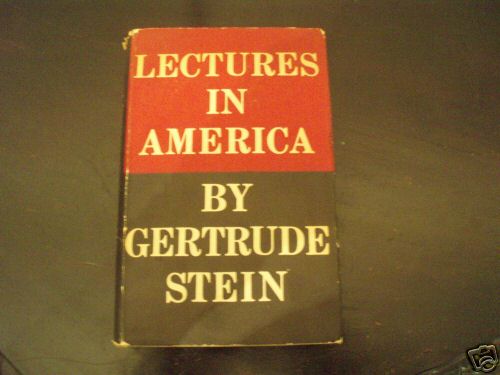
Poetry is I say essentially a vocabulary just as prose is essentially not. And what is the vocabulary of which poetry absolutely is. It is a vocabulary based on the noun as prose is essentially and determinately and vigorously not based on the noun. Poetry is concerned with using with abusing, with losing with wanting with denying with avoiding with adoring with replacing the noun. It is doing that always doing that, doing that doing nothing but that. Poetry is doing nothing but using losing refusing and pleasing and betraying and caressing nouns. That is what poetry does, that is what poetry has to do no matter what kind of poetry it is. And there are a great many kinds of poetry. So that is poetry really loving the name of anything and that is not prose.

-- Gertrude Stein

Tuesday, December 05, 2006

UCSF Library Staff Meeting

Monday, November 27, 2006

from: The Tango


some are

standing or curling rose — is not — rose (they rose)

both.

subjectivity/language is — the delicate food system
disturbed famine reappears — ?
were killed practicing in the monasteries — shipped
to labor, dying, trains shipping them, ringed in by barbed
wire haul on dam sites tunnels exhaustion famine in lines.
the same figure repeated everywhere changes it there as if
changed by not either from within or without that

---------------------

if the back’s constructed — and moves the light — is
subjectivity/language only — they’re not ‘speaking’
that is ‘speaking’ — social — both

subjectivity/language constructed also and those men
move the light — so —
social isn’t anything? there — walking — either

---------------------

moon rose — that is — appears to
moon rose
on or resting on mountain’s top — edge
horizon —
men’s delicate backs standing move — is separate —
from them
there at all — both

---------------------

future — movement
is ‘not’ night — or
‘in’ ‘night’ — either yet
ahead — so there are not functions ever

---------------------

the man standing and curling while the backs lying.
— in the place.
social — (is ‘getting along with’ people only?) or one
"doesn’t get along with people" — is functions only
(someone makes that occur — by ostracism —
one has no function then)

---------------------

the man has kindness — is standing lying — or at
night curling
where
one holds his back
at ‘night’ — ?

---------------------

must ‘accept’ death of others. — except them. except
him. (can’t) is them him also.

at ‘night’ any night is can’t

---------------------

day. moon. rose. — is on a mountain -is one’s own
back — is any night — ( isn’t the same as night)
is can’t. their separation is there.

---------------------


the flesh is not asleep while one’s sleeping. at any
time? -- no difference between ‘apprehension’ —
it’s the same in one?
— blossoming trees — outside — or ‘there not being
memory at all’ if the flesh is not asleep ever
or that’s rest as not sleeping
the relation between ‘no memory occurring’ ever
(only constructing — thought as motion — in anyone — is
physiological?)
and the flesh not asleep ever (even while one’s
sleeping) is blossoming trees ‘outside’, that is also

---------------------

the relation between the dog’s crushed back and its
seeing
apprehension isn’t by itself even. both.

crushed isn’t by itself — either skittering from side of
hurtling car on flimsy countryside

---------------------

some friend wanted faceless mother slaves. whatever
for?
not to speak, is social as people being functions? they
‘think’ it is — not to see people’s faces — there — is no
inclination on their part.
— duty — is nothing — no functions as one. both.
is wasting — wanting — speaking — social


one’s subjectivity/ language is one’s back’s motion

---------------------

he says — one suffering as is inferior then (free of
suffering being itself bliss, i.e. ‘indication’ that one is free)
and ‘that one is free’

(though it could just be — ‘materialism’ — social
acceptability. acting and speaking as ‘free of suffering’ being
that: social acceptability only)
but everyone is suffering — they’ve been killed

people’s feelings, one’s sufferings, is there wild. moon
rose and is people’s feelings wild
one’s suffering, one’s kindness — is ‘isn’t the same as
night’

---------------------

hemmed in streaming — being attached — as
conception also —
others streaming being attacked — all over the place
— she says ‘it’s never happened to her’
isn’t hemmed in streaming walking — there is no
‘outside’ — ?

she’s so protected — ‘it’s never happened to her’ —
and it’s everywhere — there’s no place. —

---------------------

as their sense that ‘the flesh itself isn’t anything’ as
opposing others et al

then it’s only one — in their ‘social’ realm — neither,
as there’s no memory et al — and the flesh’s ‘memory of
being free’ ‘as’ ‘there’

---------------------


— one’s subjectivity/language is their or one’s motion
only there?
seeing being only a motion even (in walking, say)

one has no back — yet. — not even ‘in’ ‘night’ —
not even past movements’ ‘night’ — either and is
future ‘nights’
where (?) no movement of one’s occurs — future is
same as one’s motions without extension now

one’s motion ahead — is only one now — nights rose

---------------------

to find something out — one’s motions without
extension in this place — not even — past movements’
extension now —either — nights rose.

forward into a motion where?
subjectivity/language constructed also and moves the
light — so — social isn’t ‘anything’ ? — there. — walking —
either

---------------------

he’s walking — hemmed in streaming — being
attacked

in the flesh not ever being asleep while (one’s)
sleeping — hemmed in streaming — also

at ‘night’ any night is can’t — he’s/one’s ‘outside’ in it
— both

-- Leslie Scalapino

Wednesday, November 22, 2006

from Blasted Fields of Clover Bring Harrowing and Regretful Sighs


Now the sea moves up the lawn for him as those nearby view his life passing before their eyes. Someone his own age lean in black pants and a white shirt sits on a plastic chair with a block of massive green light. Facing of someone else away (bluebird). This is not happening to him. Unaccountable ejaculation. Briefs halted at the knees alter his walk. The basement conceals a surplus of chairs while overground the yards remain square and trimmed to uniform length (clouds). This was written on his arm. Its words occupy a grid and move among cells at random with great speed. A car leaves a driveway and exclamations are made about wood left over and what could make it burn.
. . .

Stacked circles (rain down) say green it releases nothing. Bundled wires. Ellsworth Kelly strides from one red iceberg to the next. Each face projects onto antennae forging a domain expressed as a skewered pod. Transparency behind a desk elusive plunge. A dissection of thought into its components the weight of meat up the wrong street the wrong backdoor. The blazer missed too as the wiry one observed. Someone slipped him diet Orangina and he went ballistic. The whole staff crayoned their names onto the good luck card while unwitting partygoers waited for the elevator. Mogul and musician separated at birth one suggested. Hubris. The directions very specific and yet so many stood idle. She ravished in black. He charmed in lime.


—Mark Bibbins

Tuesday, November 21, 2006

RUFUS

Friday, November 17, 2006

Web 2.0 - thefirstpost.co.uk

Tuesday, November 07, 2006

Kenny Chesney - Please Come

Thursday, November 02, 2006

Bunny letter opener 兔肉開信機

Wednesday, November 01, 2006

Halloween Pumpkin

Tuesday, October 31, 2006

Cat Head Theatre

Friday, October 20, 2006

from: A Border Comedy


A cold breeze smelling of seashells and rice
And then of trees arousing me
More than city life as I experience it requires
Is pushing back the curtains by the bed where I’m lying for a little while longer
To dream
That I’m a prisoner.
But I can’t pretend to sleep while writing this.
And if you turn from this to any other didactic poem you will see the contrast
Between adventure in the meditations of a woman and imagination in the speculations of a man,
The one depending on accumulation, the other on loss and gain
Which aren’t the same for everyone, enclosed in different circles
And in different skulls
And most of them guarded
Although things get in or out sometimes—the smell of blankets
Hanging in the dark, for example,
Or the story of the father who punished his daughter for being lazy because he didn’t understand her kind of work—
But those too are ideas.
Ideas contend with stories
And this is more worthy of consideration than the judgements which separate them into “good” and “bad”
Angels.
I know the poet is vain who writes of paradise.
Experiences run together through transitions
Which are long and short at once
And so I watch the long leaves at the narrow window of my cell
And blink.
Perhaps what is most amazing is that with crimes on my conscience
I can still kiss the wall.
My containment
Consists of a series of connections
Sustaining my conviction of having done something
And every act expresses a necessity
To improve.
In over half my dreams a moral dilemma figures.
There is a grazing horse charred in a grassy corral
And a bluejay named ‘Julie’ directing a flotilla of ships through a canal
Or a convocation of logicians in striped shirts watching a boxing match
In a rural gymnasium owned by my grandfather who is sad
And the dilemma emphasizes the parallels
Whose shadows shift
Through the rationalizing ambitions of the story.
My guilt is much like Descartes’ doubt.
No—those doubts were certainties, though achieved through “pain
And other sensations
Which could not have been foreseen”
And serve as bars
Or gates
Or guards of guides.
Signifier and signified.
They are snapping the distance
In a dream with an outward gaze that’s all about a gain
Of metaphor and change of shape
At this “stopping point”
Under the pressure of the senses
Which draw from ‘nature’ and develop reality.
That’s our reason for acting.
Reason is an aid to stories.
It’s the ghost out of the cell,
Reciting what it remembers, ruling nothing out,
Like Clio or Narrator or Anonymous.
But if the flesh of the ghost is no longer under pressure
Then, like a ghost, it’s gone
From its unusual or even downright alien position,
Us,
Of which it is an imitation,
Not knowing where to go,
An aporia,
Which will allow us to go beyond the limits of any one view point
And remain there.
Though it may not seem to follow.
But I’ve gained weight, my own weight
Under my own trusted and selfish senses.
My memory is filled with their impressions
I write when nothing answers
That something appears.
A terrible slaughter occurs.
As Kwame Anthony Appiah says, technology has not yet rendered slashing and hacking obsolete.
A city is a big city or a beautiful city
Or a crowed city
Or a small progressively-governed university city
And so forth.
Intellectual systems, speech in dreams, things that change like grass
Always end in combat
(Definition: action; motivation: lack)
Resulting in expulsion
(Expulsion here assumes the nature of a certain form of justice)
But a lot of things have changed.
An anecdotal story is often a span
Consisting of separate facts
Each tenuously connected to the next.
What we respond to are the attractiveness of the facts
And the view each one provides.
There are even such things as philosophical anecdotes
Going around,
Beautifully feathered and perfectly circling
So as not to diverge even an inch from the truths
Thrown among things
And lost in the woods.
Then along comes a woodcutter wearing blue boots
And carrying a bird in a sack over his shoulder
To justify his claims
To the accuracy of the metaphors of branching and perching
He uses
To describe both story and storyteller
When asked.
Where else can one find
Justice?
The young soldier knocks on the ground and an onion shakes.
The story is never universal
Though it may repeat
And even symbolize, like rocks for good or parts for wobble
And music.
With what does a story begin?
The marvelous is a cold vehicle for ink and paper.
The power of Rosa Luxemburg could not be imposed.
But here’s an ambitious undertaking;
An attempt to account for the Twentieth Century!
Goya’s small unfinished sketch of “Time, Truth, and History”
Was painted two centuries ago at a comparable time,
(1797).
It shows Time with its hourglass bringing naked Truth into the light
While History writes.

-- Lyn Hejinian

Monday, October 16, 2006

Sweet Tired Cat

Thursday, October 12, 2006

Kitten Composer

Wednesday, October 11, 2006

The Art of Sleep

thanks MD
CATS

Tuesday, October 10, 2006

arte


Thanks MD

Wednesday, October 04, 2006

Wednesday, September 06, 2006

Archives

My Blog List

About Me

My photo
Relations and properties are objects too.